"Made in Japan" faded, and scandals of well-known Japanese companies frequently occurred.
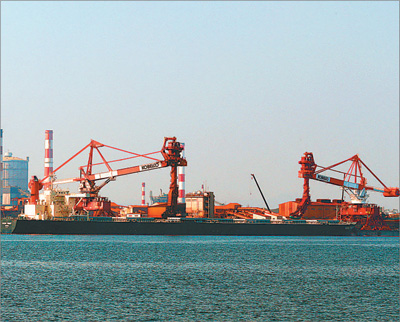
As the third largest steel enterprise in Japan, customers of Kobe Steel Works include Toyota, Mitsubishi Heavy Industries, central japan railway company and so on. The picture shows a bulk carrier docked at the factory dock of Kobe Steel Works. People’s vision
Core reading
Kobe Steel Works, Japan’s third largest steel company, recently announced that it had tampered with the performance data of some aluminum and copper products and supplied them to customers with inferior products, affecting about 200 customers such as Toyota Motor Corporation and Mitsubishi Heavy Industries. At least dozens of people, including the managers of the enterprise, participated in tampering with the data, which is a collective and long-term behavior. In this regard, Japanese public opinion is in an uproar, arguing that in recent years, there have been frequent fraud scandals of well-known Japanese companies, and the reputation of "Made in Japan" is fading.
Tampering with data, involving ten employees at management level.
According to media reports here, during an internal investigation in August this year, Kobe Steel found that four firms under the group, including Changfu Manufacturing Co., Zhengang Manufacturing Co., Ltd. and Daan Factory, tampered with the relevant quality inspection certificates, including from September 2016 to August this year, forged data such as strength and size. The tampered data products include about 19,300 tons of aluminum parts, about 2,200 tons of copper products and about 19,400 pieces of copper castings, accounting for about 4% of the sales of aluminum and copper business. According to the data of the past 10 years, the survey also found that some of them were tampered with.
Before leaving the factory, the factory involved found that some aspects could not meet the standard requirements put forward by customers, but revised the strength and size data in the product inspection certificate. However, Kobe Steel said that although these products failed to meet the requirements of customers, they met the industry standards set by the Japan Industrial Standards Survey. Kobe Steel has set up an investigation committee and entrusted a third party to conduct further investigation.
On the 8th, the vice president of Kobe Steel Works, Mr. Meiyuan Shangren, apologized for tampering with the data. He admitted that the problem product "may cause safety problems, and we also asked customers to check it." At this stage, no safety hazards that may be caused by this have been found. "
The data fraud scandal involved dozens of employees including the management of Kobe Steel Works. Meiyuan admits that tampering with the data is not done by individuals, but by the tacit approval of management, which is the overall behavior of the company.
The impact is huge and may trigger a large-scale recall.
As an upstream industrial raw material supplier, the tampering data of Kobe Steel Works has a great impact on the whole industrial chain. "Nihon Keizai Shimbun" reported that the tampering scandal of Kobe Steel will affect many industries such as aircraft and automobile manufacturing.
Toyota Motor Corporation said that it used the defective products produced by Kobe Steel, including the hoods and tailgates of some models assembled in factories in Japan. Toyota said that the company is confirming the vehicles that use these products and the possible impact, and accordingly decides the future countermeasures.
Mitsubishi Heavy Industries said that the first Japanese domestic jet, Mitsubishi regional aircraft, which it was developing used the defective products of Kobe Steel Works. It is understood that the products of Kobe Steel Works are used in the fuselage, wing joint and window frame of Mitsubishi regional aircraft. The performance of airlines is deeply affected by the fluctuation of fuel prices, so owning a plane with less fuel consumption is directly related to the performance. The use of aluminum parts from Kobe Steel Works and carbon fibers from Toray Co., Ltd. can reduce the weight of aircraft parts, which were once the advantages of Japanese raw material enterprises.
Some Shinkansen trains operated by Japanese central japan railway company Company also use the defective products of Kobe Steel Works. Kyodo News believes that the influence of data tampering has extended from automobile manufacturers to Shinkansen, aerospace and other fields. Once it is confirmed that there are problems such as insufficient strength of important parts related to automobile safety, the data fraud scandal may escalate into a large-scale recall.
Frequent scandals have shaken the "high quality" of Japanese manufacturing.
Meiyuan said that it is not ruled out that some customers will recall the problem vehicles, and they are currently negotiating with relevant enterprises. Meiyuan attributed some of the reasons for tampering with the data to the pressure of on-time delivery, and he also denied that the management had put pressure on the production line because of the financial deficit.
In fact, Kobe Steel Works exposed a tampering data scandal in 2016. One of its subsidiaries producing steel wires continued to forge the strength of stainless steel products for nine years, and sold stainless steel products that did not meet the industry strength standards as qualified products, affecting products including water heaters and other household appliances and cars.
According to the analysis of Nihon Keizai Shimbun, four enterprises under Kobe Steel Group have used the same method for a long time to make fraud, which shows that many employees agree with the improper behavior of enterprises. The transaction between enterprises should have adhered to the principle of "no bullying", but when Kobe Steel Company called "striving to reach the industry standard", it forgot the contract consciousness between customers and even used deception to maintain customers. This has a negative impact on the overall credibility of Japanese manufacturing.
The report also said that the Japanese manufacturing industry, which used to be a selling point of "high quality", is shaking.
In recent years, scandals of well-known Japanese companies have occurred frequently. For example, three presidents of Toshiba participated in financial fraud, and Mitsubishi Motors and Suzuki tampered with automobile fuel and economic test data, which made people criticize the corporate governance of large Japanese enterprises. Wu Baoning, director of the Japan Institute of Modern Culture, believes that on the one hand, downstream enterprises are demanding higher and higher costs for upstream enterprises; on the other hand, enterprises emphasize creating profits and income, ignoring social responsibilities, and how to balance the relationship between them requires interest adjustment. In addition, how the state supervision, the supervision within enterprises and the supervision of users interact with each other is also a subject worthy of consideration.
(Our correspondent in Japan, Tian Hong, newspaper, Tokyo, October 10th)