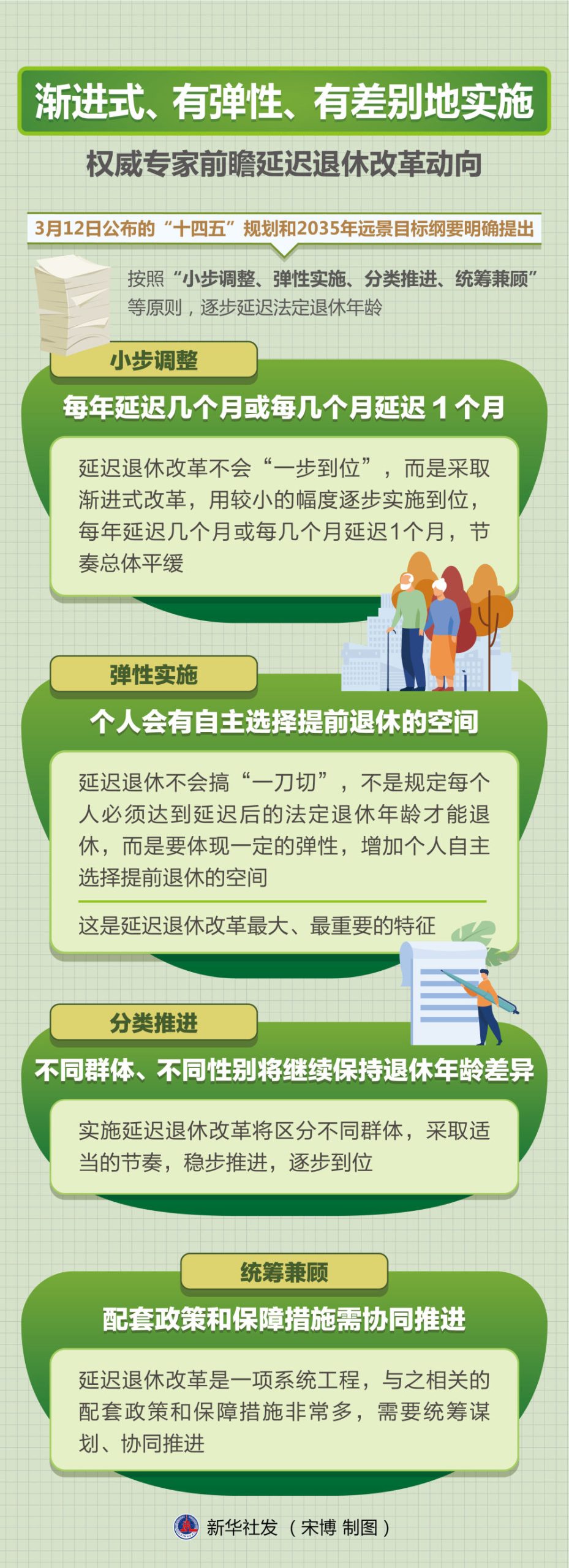
Gradual, flexible and differentiated implementation-authoritative experts look forward to the trend of delayed retirement reform
Xinhua News Agency, Beijing, March 13th Title: Implement it gradually, flexibly and differently — — Authoritative experts look forward to the trend of delayed retirement reform
Xinhua News Agency reporter Jiang Lin
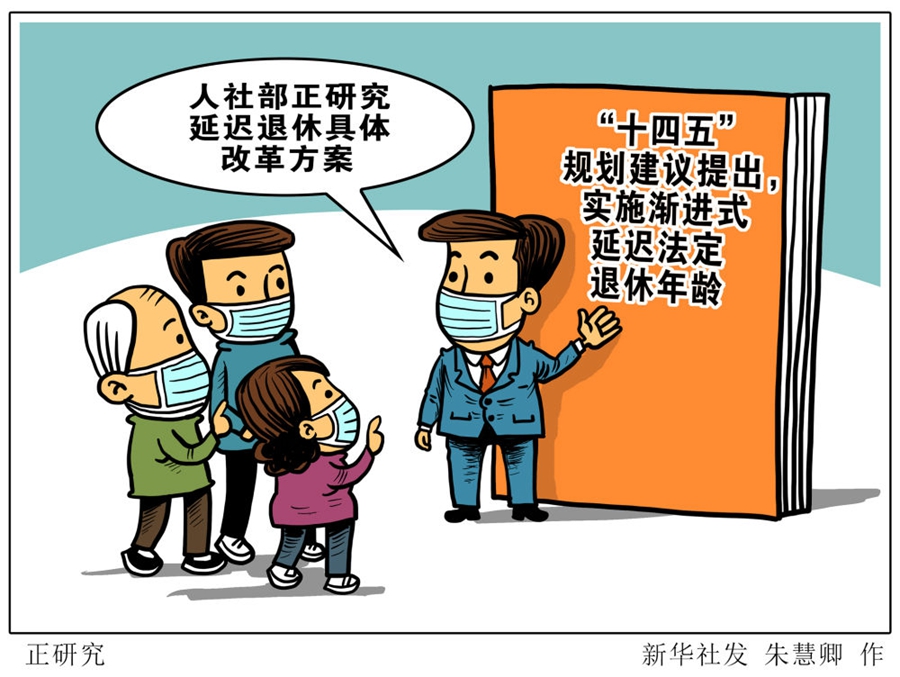
The 14th Five-Year Plan and the outline of the long-term goals for 2035 announced on the 12th clearly stated that the legal retirement age should be gradually delayed according to the principles of "small-step adjustment, flexible implementation, classified promotion and overall consideration".
What do these principles refer to respectively? How to change it next? The reporter interviewed Jin Weigang, president of China Academy of Labor and Social Security, Ministry of Human Resources and Social Security.
Small step adjustment — — Delay for several months every year or one month every few months.
Jin Weigang: The simple understanding of small-step adjustment is that the delayed retirement reform will not be "one step in place", but a gradual reform will be adopted, and it will be gradually implemented in a small range, with a delay of several months every year or one month every few months, and the overall pace is gentle.
In other words, after the implementation of the policy, the retirement age line will be slowly pushed back. For example, women who have retired at the age of 50 will retire at the age of 50 for one month or several months in the first year after the implementation of the policy. People of different ages have different retirement ages. By analogy, the reform will be completed after several years of transition.
What is certain is that in the early stage of the reform, people who are about to retire will only be delayed by one month or several months, and there will be no situation of retiring for several years at once.
For young people, the extended retirement age will be larger, but there will be a long transition period and adaptation period in the future.
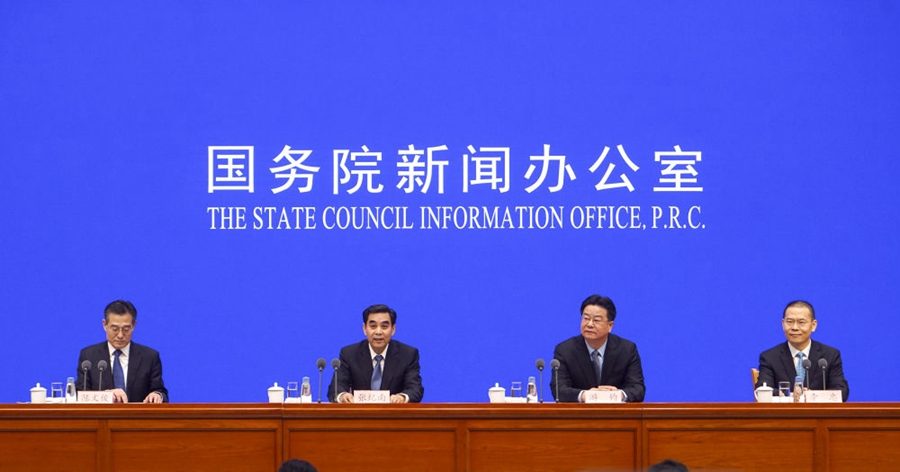
On February 26th, the State Council Press Office held a press conference. You Jun (second from right), Vice Minister of Ministry of Human Resources and Social Security, revealed at the meeting that the Ministry of Human Resources and Social Security is working with relevant departments to study specific reform plans for delaying retirement. Xinhua News Agency reporter Yin Gang photo
Flexible implementation — — Individuals will have the freedom to choose early retirement.
Jin Weigang: Delayed retirement will not be "one size fits all". It is not to stipulate that everyone must reach the delayed legal retirement age before retiring, but to reflect certain flexibility and increase the space for individuals to choose early retirement independently.
This is the biggest and most important feature of the delayed retirement reform.
Objectively speaking, there are great differences in terms of employment stability and work intensity of different occupational groups and positions, as well as personal physical condition, family needs and value pursuit, resulting in different demands. Some people hope to work more, while others hope to retire early.
Delayed retirement reform should fully consider these diversified needs. On the basis of unified implementation, combined with China’s actual national conditions, cultural traditions and historical evolution, we will increase the flexibility factor and allow individuals to choose the specific time for early retirement according to their own conditions and conditions, which fully reflects the flexibility and inclusiveness of the reform.
Classification promotion — — Different groups and genders will continue to maintain the difference in retirement age.
Jin Weigang: Delayed retirement is not a "quick march", but a smooth connection with the current retirement policy.
At present, the legal retirement age in China is 60 for male workers, 55 for female cadres and 50 for female workers, and the policies are different. The implementation of delayed retirement reform will distinguish different groups, adopt appropriate rhythm, advance steadily, and gradually reach the designated position.
For some existing policy differences in different occupations, regions and posts, policy continuity will be maintained after the reform to ensure orderly convergence and smooth transition before and after policy adjustment.
Overall consideration — — Supporting policies and safeguard measures need to be promoted in coordination.
Jin Weigang: Delayed retirement cannot be "single-handed". Delayed retirement reform is a systematic project, and there are many supporting policies and safeguard measures related to it, which need to be planned as a whole and promoted in coordination.
On the one hand, some policies related to retirement age in the past should be adjusted accordingly with the delay of retirement; On the other hand, the delayed retirement reform will also bring some new problems and challenges, which need corresponding supporting measures to follow up in time.
For example, how to promote the employment and entrepreneurship of older workers through more targeted measures? How to give social security subsidies to people with employment difficulties, especially those with flexible employment, to help them re-employment? How to further strengthen the protection of older unemployed people and develop jobs suitable for older workers? There are also amendments to relevant laws and regulations.
Only by making overall plans and taking supporting measures in place can we ensure the smooth implementation of the delayed retirement reform.