Zhengping Liu
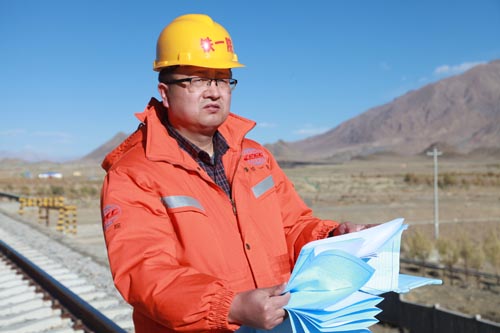
CCTV News:Zhengping Liu, male, born in April 1971, Han nationality, party member, commander of Lhasa Branch of China Railway First Survey and Design Institute Group Co., Ltd.
Liu Zhengping and his team organized and completed the testing of more than 800 ground temperature observation well in the frozen soil area along the Qinghai-Tibet Railway, and drew the first 1: 200,000 scale Zoning Map of Frozen Soil of Qinghai-Tibet Railway in China, which innovatively formed the world-leading comprehensive survey technology of frozen soil, and cast a "sea-fixing needle" for the Qinghai-Tibet Railway to build a world-class plateau frozen soil railway.
Honors: National Model Worker, National May Day Labor Medal.
Zhengping Liu, male, born in 1971, Han nationality, party member, Shaanxi Fufeng, master of engineering, professor-level senior engineer, graduated from Xi ‘an Institute of Mining in 1993, and is currently the commander of Qinghai-Tibet Railway expansion and reconstruction project of China Railway First Survey and Design Institute Group Co., Ltd. He has been rooted in the front line of geological work for 26 years, including 19 years in Xizang, presided over and participated in the geological survey, design, scientific research and summary compilation of many national key construction projects such as Qinghai-Tibet Railway and Lari Railway, and made outstanding contributions to solving major technical problems such as plateau railway, permafrost, geothermal and sandstorm, and won 12 scientific and technological awards at or above the provincial level, such as National Science and Technology Progress Award and National Survey Gold Award, National Model Worker, National May 1 Labor Medal and Xizang.
19 years of persistence and persistence
Since 2000, he has successively served as the head of geological specialty in the survey and design of the Qinghai-Tibet Railway and the leader of the frozen soil research team with the most arduous mission. He has participated in the initial survey, final survey, supplementary survey, cooperative construction, summary and compilation of the Qinghai-Tibet Railway, and the compilation of plateau frozen soil railway specifications, and has formed an indissoluble bond with the Qinghai-Tibet Plateau.
After the completion of the Qinghai-Tibet Railway, he continued to observe the frozen soil during the operation on the Qinghai-Tibet Plateau. In 2010, he fully engaged in the survey, design and construction of Largo Railway, and served as the deputy general and deputy commander of survey and design. At present, he is responsible for the cooperation construction of the capacity expansion and reconstruction project of the Qinghai-Tibet Railway. From 2016 to 2018, he actively participated in the design of Tibet Railway Network, China-Nepal Railway, New Tibet Railway, Lamo Railway and other projects. In the past 19 years, he insisted on working at the site for more than 9 months every year, overcoming the severe plateau hypoxia and harsh natural environment, giving up his love for everyone and devoting himself wholeheartedly to the construction of modern transportation in Xizang Autonomous Region, which has withstood the test of human body and spirit from the roof of the world and embodied the mission and responsibility of a communist party member. From youth to gray temples, he devoted the most precious time in his life to realize the century-old dream of a train leaping onto the roof of the world.
Climbing the "Mount Everest" of Plateau Frozen Soil Railway
Building a railway on the Qinghai-Tibet Plateau is facing a worldwide problem of permafrost. Liu Zhengping and the technical team of the First Institute of Tieyi devoted themselves to tackling the worldwide engineering geological problem of the plateau railway with the spirit of being brave in danger and climbing the peak. Many research results were appraised by the state and applied to other high-cold railway designs, which produced great economic and social benefits. Through ten years’ operation practice, the correctness of frozen soil engineering design has been verified, which has promoted and met the needs of the continuous construction and development of Qinghai-Tibet Plateau Railway.
During the investigation of the Qinghai-Tibet Railway, he organized and carried out various "high-precision" work related to the Qinghai-Tibet Railway, such as comprehensive geological route selection, investigation of permafrost regions, long-term monitoring of permafrost ground temperature, selection of frozen soil test sections, follow-up investigation of the Kunlun Mountain M8.1 earthquake, investigation of sandstorm along the line and investigation of active faults along the line, which laid a good foundation for stabilizing the line scheme.
The ground temperature of frozen soil is the foundation and soul of frozen soil engineering design. In order to ensure the authenticity and reliability of the ground temperature test data, Liu Zhengping and his team conducted numerous field investigations in advance. He pursued link control and reduced the error of ground temperature test, summed up the key operation links of ground temperature test, and formed the Operating Rules for Ground Temperature Test, which made the accuracy of ground temperature test reach 0.02℃, increased by five times, accurately reflected the ground temperature environment of frozen soil, provided a basis for engineering design and greatly reduced the test. The results of "Operating Rules for Geothermal Testing" were published in journal of railway engineering society, and were widely used in the geothermal testing of Lanzhou-Xinjiang high-speed railway, Muli railway, Harbin-Dalian high-speed railway and Lari railway.
Together with his team, he organized more than 40 geothermal observation well sites along the Qinghai-Tibet Railway to carry out ground temperature tests for six years, surveyed every landform point, investigated every phenomenon of bad frozen soil, treated every ground temperature data rigorously, obtained about 120,000 groups of ground temperature data, and drew the 1: 200,000 Annual Average Ground Temperature Zoning Map of permafrost regions of Qinghai-Tibet Railway. The Zoning Map of Annual Average Ground Temperature in Permafrost Region of Qinghai-Tibet Railway is the first zoning map of permafrost temperature of Qinghai-Tibet Railway in China, which lays a solid foundation for the final innovation and formation of the world-leading comprehensive survey technology of frozen soil.
He contributed to the formation of "China Standard" for frozen soil engineering technology. He presided over the compilation of Code for Survey and Design of Plateau Railway, Technical Specification for Construction of Plateau Railway Engineering and Acceptance Standard for Construction Quality of Plateau Railway Engineering. He redefined the noun explanation of "bad frozen soil phenomenon", which was recognized by frozen soil experts of Chinese Academy of Sciences and incorporated into the specification. As the editor-in-chief of the three codes, he fully draws lessons from the successful experience of Qinghai-Tibet Railway and pays attention to absorbing the achievements of railway frozen soil engineering in cold regions of China in recent ten years. After more than two years’ efforts, he has successfully compiled and passed the examination, laying the foundation for the successful transformation of frozen soil research achievements into technical standards, the standardization and standardization of technical work, and the wide popularization and application.
The success of the Qinghai-Tibet Railway engineering design has caused a sensation in the international frozen soil railway construction. Russia’s Moscow-Kazan high-speed railway and Tuva-Yarsk railway have conducted many consultations and exchanges with China on the frozen soil railway construction technology, which also shows that China’s frozen soil railway technology has gone global and realized the transformation from "student" to "teacher".
Persistence in frozen soil research
The research on permafrost in Qinghai-Tibet Railway is based on the research on permafrost in China for 50 years. Zhengping Liu paid persistent attention to frozen soil research. From 2000 to 2006, he was the head of Qinghai-Tibet Railway Geology. He successively served as the vice captain and captain of Qinghai-Tibet Railway Frozen Soil Research Team, responsible for the on-site management of 66 ministerial-level scientific research projects, and served as the leader of 13 of them. Under the impetus of his organization, the research work on frozen soil of Qinghai-Tibet Railway has been carried out in a solid way, and the test results have been innovated, which successfully revealed the mechanism of cooling the foundation by engineering measures such as flaky air cooling, gravel slope protection, hot rods and ventilation pipes, and provided scientific basis for finally solving the technical problems of frozen soil.
From 2006 to 2016, during the operation of the Qinghai-Tibet Railway, he did not stop the study of frozen soil, and actively carried out long-term monitoring of frozen soil during the operation period, which provided a basis for explaining the long-term effect of the permafrost project of the Qinghai-Tibet Railway. During this period, he presided over the completion of the Qinghai-Tibet Railway Survey and Design Volume, which was published in 2016 with a book of 690,000 words. He actively participated in many domestic and international academic conferences, was invited to give lectures on permafrost in universities and scientific research units, and published 39 papers in various journals, which has a wide reputation in the industry.
In the capacity expansion and reconstruction project of Qinghai-Tibet Railway in 2016, he served as the commander, and carried out the research on the disease treatment of frozen soil railway. At present, he actively participated in the electrification project of Qinghai-Tibet frozen soil railway, and actively participated in and advocated the frozen soil research in western Tibet with the construction of the National Belt and Road.
"Liu Beidou" of La-Ri Railway
Lari-Ri Railway is the railway with the longest geothermal section and the highest geothermal temperature in China at present. The length of the railway passing through geothermal section is about 47 kilometers, and the proven maximum hot spring temperature is 88℃. As the deputy chief designer of Lari Railway Geology, Zhengping Liu made a detailed geological survey of the geothermal area, based on the ground temperature test and the processing of ground temperature data, and presided over the drawing of the 1: 10,000 ground temperature point distribution map of the Yarlung Zangbo River Gorge. From the map, the spatial distribution and temperature range of geothermal energy can be clearly seen, which provides the most intuitive basis for railway route selection and site layout.
During the comparison and reconnaissance of four route schemes from Lhasa to Shigatse, he walked through 12 of the 18 counties and cities in the Kaze area, crossed the Renbu Snow Mountain at an altitude of 4,500 meters, traveled all over the gullies and ridges around Yangzhuo Yongcuo, investigated all kinds of complex terrain around Yangbajing gas-hot field, and visited various Tibetan villages on both sides of the Nianchu River. In the Gobi desert section from Denggu Village to Luosang Village in Shigatse area, the surface vegetation is barren, there are few tall markers, and there are no obvious roads. During the field investigation, people often get lost, and even the local villagers can’t tell the direction of the roads, but Zhengping Liu knows the location of this section like the back of his hand. Whenever the leaders of the Ministry of Railways and the autonomous region go to the site for inspection, he always leads the way. The leader of Xizang Branch Railway Office joked: "We are very familiar with this area, but we can’t find the north here. We can’t find these roads without you. You are really the big dipper of navigation." So the name "Liu Beidou" spread all at once.
Through the in-depth study of the field situation and geological conditions, Zhengping Liu’s geological survey provided detailed basis for the scientific, economic and reasonable route selection of the railway, which made the scheme along the Yarlung Zangbo River become the final scheme from four comparison schemes, saving 88.91 million yuan in engineering investment.
Model worker studio helps young people grow up.
He paid attention to the cultivation of young people, and set up the Zhengping Liu Model Worker Innovation Studio. At present, there are 9 scientific research projects around the railway construction in Tibet, including 1 national special prize for scientific and technological progress, 1 gold prize for survey, 2 first prizes for provincial and ministerial scientific and technological progress, 2 second prizes and 1 third prize, which effectively promoted the scientific and technological innovation and development of enterprises. Members of the studio published more than 20 papers. There are 11 scientific and technical personnel, 1 senior teacher, 5 senior engineers and 5 engineers. Zhengping Liu Model Worker Innovation Studio is the first model worker studio in Xizang Autonomous Region and one of the 100 model worker studios in China.