The spread and influence of Mao Zedong’s poems in the world
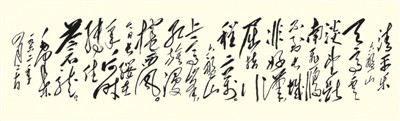
At the end of 2015, I visited Sri Lanka with the delegation of China Publishing Promotion Association and was received by the current President, Mr. Sirisena. During the meeting, President Sirisena asked whether the Poems of Mao Zedong could be translated into the Tam version of Sangha, and asked the delegation for a portrait of Mao Zedong to hang in his bedroom. This request is beyond the expectation of all members of the delegation. Later, I learned that Mr. Sirisena is a typical "Mao Fan", and the stories of the older generation of China leaders such as Mao Zedong and Zhou Enlai are widely known in Sri Lanka.
As a scholar who has long been concerned about the overseas spread of China culture, I am more interested in the process of "Poetry of Mao Zedong" gaining world influence, and it is of great theoretical and practical significance to sort out the course of its external spread.
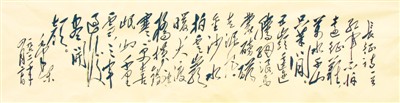
The Seven Laws Long March is the first song translated into a foreign language.
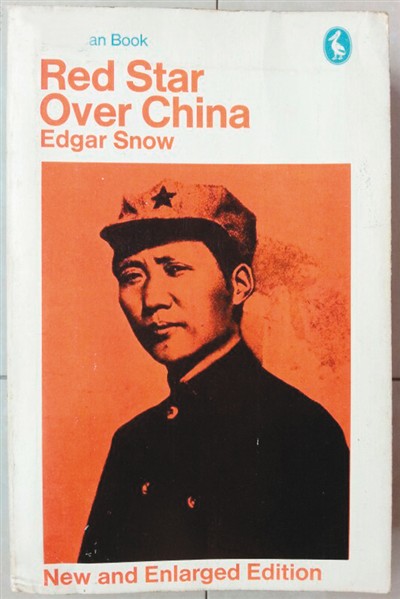
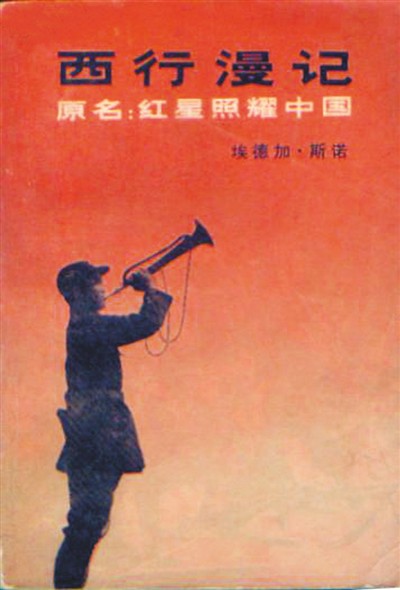
One of Mao Zedong’s poems first seen by readers all over the world should be the Seven Laws Long March translated into English by American journalist edgar snow in 1936. Since then, Mao Zedong’s poems have been spread overseas for 80 years. At the end of the fifth chapter "Long March" in "Red Star Shines on China" written in 1936, Si Nuo quoted this poem by Mao Zedong to illustrate the spirit of communist party people in the adversity of China revolution. As the first book to introduce China’s revolutionary course to the world, Red Star Shines on China has gained a sensational influence in the English-speaking world. Mao Zedong, as the leader and poet of China’s revolution, was also known to the western world for the first time through this book, and the Seven Laws Long March has also become the most famous one of Mao Zedong’s poems.
Shortly after the founding of New China, China and the Soviet Union established good political relations. In 1957, the Soviet Union published a Russian version of 18 Poems of Mao Zedong, which was translated by sinologists Federlin and Eidelin, with a print run of 150,000 copies. This is the first foreign language version of Mao Zedong’s poems. Later, Czechoslovakia, Hungarian, French and other countries also published Mao Zedong’s poems. For example, the Hungarian version was translated by Shan Duoer, a famous sinologist, with the title "21 Poems of Mao Zedong", which was published in 1958. In 1965, France published the French version of Ten Poems of Mao Zedong translated by the famous sinologist Dai Miwei. In 1969, the French published The Complete Collection of Mao Zedong’s Poems, and translated 38 Mao Zedong poems, which were translated by the famous scholar Yi Brossolet. The Japanese version of Mao Zedong: His Poetry and Life was translated by Takeuchi Minoru, a famous Japanese sinologist. Before its publication, it published a reservation advertisement. After its publication in May 1965, all Japanese newspapers published book reviews.
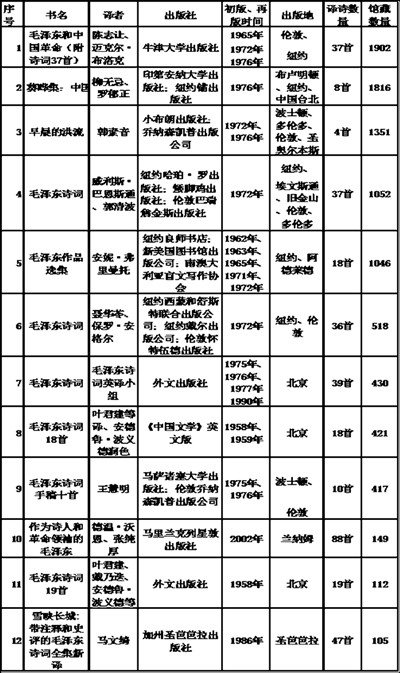
During the 80-year spread, Mao Zedong’s poems have been translated into nearly 40 languages, including English, Russian, French, German, Italian, Dutch, Spanish, Portuguese, Greek, Arabic, Korean, Vietnamese, Thai, Japanese, Indonesian and Malay. Among them, according to the collection statistics, the English version is the most influential. Based on the Universal Library Bibliographic Database, the author searched more than 100 editions of the world’s collection libraries in June 2016, and found that there are 12 influential translations of Mao Zedong’s poems, all of which are English versions (see table).
Through the 12 translations in the table, we can find that the largest collection is Jerome Chen and Michael Brock’s Mao Zedong and China Revolution, which was published simultaneously by Oxford University Press in London and new york in 1965. This book was written independently by Jerome Chen, but the 37 Mao Zedong poems in the appendix were written by Jerome Chen and Michael Brock. Because Jerome Chen is familiar with the revolutionary history of China, the translation of Mao Zedong’s poems is comprehensive and profound, so this book has the greatest influence.
The artistic value of Mao Zedong’s poems has been fully concerned.
The evaluation of Mao Zedong’s poetry art was influenced by Mao Zedong’s political position as the leader of China for a long time, and its artistic value was not paid enough attention until the 1970s. The second largest collection in the table is "Kwai Yeh Collection: Three Thousand Years of China’s Poetry", which was compiled by professors Liu Wuji and Luo Yuzheng of Indiana University in 1975. The book contains nearly 1,000 poems, words and songs translated by more than 50 translators by famous writers in China’s history, and the book contains eight translations of Mao Zedong’s poems. Since its publication in 1976, this book has been used as a textbook for teaching China literature by many American universities, so Mao Zedong’s poems are known to many western young people. The earliest person who paid attention to Mao Zedong’s poetic art beyond his revolutionary leadership was American poet and professor Willis Barnstone. In 1972, his poetry of Mao Zedong, which was translated by Guo Qingbo, was published simultaneously in new york, Evanston, San Francisco, London and Toronto. There are 37 English translations of Mao Zedong’s poems, as well as the calligraphy handwriting of Mao Zedong’s poems "Qingpingle Liupanshan".
China’s initiative to spread the Poems of Mao Zedong to the outside world began in 1958. In 1958, there were 18 English translations of Mao Zedong’s poems published in the third issue of China Literature magazine, and there were no translators when they were published. However, according to the textual research of later recalled articles, these translators were translators Ye Junjian, Qian Zhongshu and Yu Baodi, the head of foreign languages press’s English group, and Andrew Boyd, an English expert of Foreign Languages Society, polished the translated poems. There are 421 collections of this magazine in the world. In September, 1958, foreign languages press published Nineteen Poems by Mao Zedong. In addition to the 18 poems in China Literature magazine, the poem "A Answer to Li Shuyi by a Butterfly Lover" was translated by a British expert, Ms. Dai Naidie. In 1964, the state set up a group to translate Mao Zedong’s poems into English, and 39 translated poems were carefully crafted, standardized and accurate, which became reference models for translations in other languages. But the translation was not published by foreign languages press until 1976. In addition, there are more than 10 domestic English versions of Mao Zedong’s poems, including those of Xu Yuanchong, Gu Zhengkun, Huanglong and Zhao Hengyuan, all published after 1992.
Dual effects of political diplomacy and cultural communication
Poetry expresses ambition. The main reason why Mao Zedong’s poems gained world influence is that they condensed the spirit of the Chinese nation. As Takeuchi Minoru, a famous Japanese sinologist, said in his book "Poetry and Life of Mao Zedong", "Mao Zedong’s life overlaps with the development of the China Revolution, and his poetry is not only the longing for the revolution in his inner world, but also the spiritual reflection of the China Revolution." Mao Zedong’s poems reveal the true feelings of a great man in the world, and at the same time, they can be regarded as the spiritual portrayal of the Communist Party of China (CPC) and China people’s various processes of getting rid of the invasion of foreign powers, gaining national independence and building a new China. Therefore, the external communication of Mao Zedong’s Poems has the dual significance of integrating political diplomacy and cultural communication.
The most famous case is President Nixon’s visit to China in 1972. According to Wu Shousong’s "Poems of Mao Zedong Published for President Nixon", on February 21, 1972, when Nixon made a toast at the welcome dinner hosted by Premier Zhou, he even quoted a Mao Zedong poem: "How many things are never urgent; Heaven and earth turn, and time is pressing. Ten thousand years is too long to seize the day. " Nixon became the first foreign leader to quote Mao Zedong’s poems in a public speech. The next day, when Nixon visited the Badaling Great Wall, he recited Mao Zedong’s poem "Spring in the Garden and Snow" and asked the Chinese Foreign Ministry personnel for the English version of "Poems of Mao Zedong". Through Mao Zedong’s poems, Nixon conveyed the desire of the United States to seize the day and establish good international relations with China. This incident was immediately spread as a story in the field of foreign cultural communication.
Mao Zedong’s Poems won the attention and praise of many foreign leaders, and for a long time became the generous gifts and negotiation materials that politicians in China were vying for at that time, which won a common discourse space for China’s diplomatic activities. In the 21st century, Sri Lankan President Sirisena proposed the translation of Poems of Mao Zedong, which shows that this influence still exists, but it comes more from the profound ideological connotation and aesthetic implication of Mao Zedong’s poems, and the image of poet Mao Zedong is becoming clearer and clearer.
(He Mingxing The writer is a professor at Beijing Foreign Studies University)